Monday, June 25, 2012

Witnesses in Stone

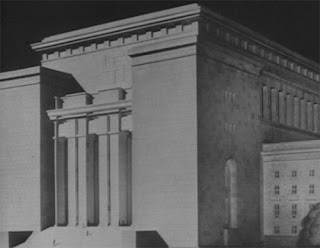
'Every structure left to us by history expresses the spirit of it's builder.

Brutaliat in Stein: Die Ewigkeit von Gestern (1960) [Brutality in Stone: Yesterday Goes on for Ever] is an experimental film by Alexander Kluge (b.1932).  It depicts the abandoned Nazi architecture, strikingly void of human life and disturbingly illustrates the utilization of inhuman and super-human scale that attempted to bolster the political regime of the same. Shots of huge neo-classical architectural structures from the Nazi period are confronted with equally anti-human national-socialist language as a voice-over. Kluge intersperses the film footage from the early 1960s with various images dating from 1933 to 1945, including photographs of Adolf Hitler drawing building plans, his personal sketches, and drawings of reconceived German cities.


http://www.youtube.com/watch?v=islUtYwOOx8&feature=player_embedded' 


Alexander Kluge is a German filmmaker and author, published in English by Seagull Books.

Saturday, June 23, 2012

My Body Lying in the Heather

One night when I had tasted bitterness in my mouth I went out on to the hill. Dark heather checked my feet…Two lights for guidance. First our little glowing atom of community, with all that it signifies. The second, the cold light of the stars, symbol of the hypercosmical reality, with its crystal ecstasy.

Duncan Marquiss, Midday, 2011. Courtesy of the artist.

Olaf Stapledon’s science fiction novel Star Maker (1937) begins with the mysterious freeing of the unnamed protagonist’s consciousness from the confines of his body. Newly unencumbered, our narrator departs suburbia for distant solar systems, sprawling galaxies and alien civilisations. As he journeys the narrator’s psyche is revealed as an endlessly malleable entity, dividing and expanding, merging with individual and group minds to eventually play its minute role in forming a vast cosmical consciousness. In this remarkable work Stapleton recounts the history of the universe as seen through the prism of an individual mind.

In the year 2000 a stone circle was erected in Milton Keynes. Titled ‘The Circle of Hearts Medicine Wheel’, it consists of two concentric circles of stones with longer stones positioned at each compass point. Situated on the energy line said to run through Midsummer Boulevard in the centre of Milton Keynes, this modern Neolithic structure accesses Pagan traditions and pre-Christian resonances. It is during the short period of Midsummer that this ancient ley line becomes visible, as the sun rises in precise alignment with Midsummer Boulevard, Avebury Boulevard and Silbury Boulevard. Built to mark the millennium and intended as a meeting place for the city’s residents, the monument brings the presence of deep time to an urban environment seemingly lacking an extended history of its own.

The summer solstice marks the day on which the axial tilt of the Earth, in a given hemisphere, is most inclined towards the Sun: an astronomical happening that signifies an extremity of light, a marker of time and movement through the seasons. These films have been bought together to coincide with this event. Each work has a complexity linked through the interplay of light and the self against, before and within the film/video medium. In Lucy Reynolds’s Lake (Nocturne) artificial light plays eerily across a landscape we cannot situate, the uncanny effect directing us to a world played for film and the world outside of it. Duncan Marquiss’s two videos, Midday and Late Cinema, flicker across the screen, drawing our bodies in as the oscillation of images strikes our nervous systems. Sarah Pucill’s Blind Light is rendered with great economoy, as the substance of film is so exceeded by light, touch and feeling. The work provokes the suspension of the everyday world, as image, as the body and psyche ceaselessly coalesce and break away.  In Kim Coleman & Jenny Hogarth’s If You Can’t See My Mirrors I Can’t See You we are in turns suspended, as real and virtual spaces enmesh, encircling objects and subjectivities, in a feedback loop of the artists making.

We have a desire to begin to unpack the relations between imagined psychical space and our bodies in this place. On the lightest day we arrive weighed down with a projector, discs and neat spirals of film. Our lived experience is of body and image enfolded into the world. Film produces, through a unique combination of dichotomies (light/dark, visual/sound, past/present), a disjuncture between the two. As once began a lecture on film given by the ineffable Hollis Frampton, ‘we are, shall we say, comfortably seated. We may remove our shoes, if that will help us to remove our bodies’1.

1 Hollis Frampton, A Lecture. New York, 1968.

Laura Guy & Elsa Richardson, 2012

Friday, June 22, 2012

ABIDJAN a thought on the naming of new towns...


Abidjan is the colonial capital of Côte d'Ivoire and the country's largest city. In 1933 a port was built and the new city grew.

According to oral tradition of the Ebrie as reported in the Encyclopedic Dictionary of Côte d'Ivoire, the name "Abidjan" results from a misunderstanding. Legend states that an old man carrying branches to repair the roof of his house met a European explorer who asked him the name of the nearest village. The old man did not speak the language of the explorer, and thought that he was being asked to justify his presence in that place. Terrified by this unexpected meeting, he fled shouting "min-chan m'bidjan", which means in the Ébrié language: "I just cut the leaves." The explorer, thinking that his question had been answered, recorded the name of the locale asAbidjan. Wikipedia of course. 

Is this true, and what is involved in the process of naming a New Town? In Milton Keynes, the name was that of the smallest village surrounding the new town centre in order to avoid competition between the largest dwellings in the region. Shenzhen means "deep drains", a descriptive title of the cities geography which used to be a delta with streams and rivers throughout - that was before the bulldozers arrived and reclamation began. Thamesmead launched a competition in the Sunday Times to suggest names for the new town. One of the suggestions, New Wooabbeleri became the title of artist Stuart Whipp's project of 2011.

What does a name designate? How does a population relate to the name of town in which they live? Does choosing the name of the small hamlet that once stood in the new town's place offer some kind of panacea to the lack of material heritage in a new city? 


Friday, December 30, 2011

The antithesis of Brazilia?

Very close to Brasilia, a woman truck driver created this alternative to the capital.

Friday, November 11, 2011

Community without Propinquity Closing Event - 26 November, MK Gallery, Milton Keynes


Community without Propinquity* is a project exploring the role of contemporary art and understandings of community in New Towns across the globe. It includes an exhibition with work from Paulo Catrica, Nathan Coley, Jesal Kapadia, Wayne Lloyd, Vincent Meessen, Ishmael Randall Weeks, Pia Rönicke, Stuart Whipps, Bai Xiaoci and video programme including Amanda Beech, Cyprien Gaillard, Dominique Gonzalez Foerster, Pierre Huyghe, Minouk Lim, Corey McCorkle, Vincent Meessen, Pia Rönicke and Huang Xiaopeng.

For October and November, the The Project Space at has been an active Research Laboratory and forum for public events and new artist commissions. The focus of the research has been on the meaning of "community" in New Towns. The closing event will frame this work and research within a panel discussion, the launch of a publication published by ANDPublic and And Endless Supply and the first chance to see new work by the six commissioned artists including Caroline Devine, Patrick Staff, Emma Smith, Kelly Large and Mark Aerial Waller.

14.00-15.00 FILM SCREENING (Video Space) Looped
Pierre Huyghe, Streamside Day Follies (2003)

15.00-17.00 PANEL DISCUSSION (Events Room)
Guest Panelists: David Lock, Anthony Iles, Roman Vasseur
Chair: Claire Louise Staunton

David Lock CBE has been an urban planner in MK since 1977, is a founder member of the MK Urban Studies Centre and, in 1987, became President of Milton Keynes City Discovery Centre.

Anthony Iles is a cultural engineer and writer researching and making experiments in the disappearing public sphere. He is Assistant Editor of Mute magazine.

Roman Vasseur is an artist and curator. In 2008 he was appointed ‘Lead Artist’ to Harlow, a post-war New Town in Essex, in the build up to the town’s second phase of regeneration.

17.00 ARTISTS PRESENTATIONS/ACTIONS (Events Room)
Kelly Large, Emma Hedditch and Emma Smith

17:45 SCREENING & Q&A (Events Room)
Carry Gorney introduced by Mark Aerial Waller, followed by a screening of her work at MK Channel 40, Sweet Sixteen and Things that mother never told us.

Carry Gorney is a Systemic Psychotherapist and writer. She has worked with Inter-Action in London and Milton Keynes, developing the use of video for community participation. This became the basis for a series of television programmes broadcast on MK Channel 40 from 1977 to 1979. Mark Aerial Waller is an artist and has been commissioned to make a new work for the Research Lab, to be presented at the event.

19:00 PERFORMANCE (Events Room)
Patrick Staff, Performance, Growth, Forecasts (2011)

A video and performance work by artist Patrick Staff with Milton Keynes' Madcap Performers. The work has developed out of a period of research at the archive of the Milton Keynes Discovery Centre, involving a number of interviews with key planners and academic researchers and participatory workshops. The project explores urban design, growth developments, the history of the garden city and New Town movements with a particular focus on the role of the irrational, mystic and holistic in these plans and cities and how such knowledge is produced, circulated and understood by a community.

All Day EXHIBITION (Project Space)

Generously supported by Arts Council England, Vision Forum, Milton Keynes Community Foundation with assistance from the MK City Discovery Centre

Tuesday, September 13, 2011

Community without Propinquity in Milton Keynes

Community without Propinquity is a project exploring the roles of contemporary art and communities in New Towns across the globe. The project includes an exhibition, a video programme, six new artist’s commissions, a research laboratory, publication and symposium.
The exhibition, in the Project Space, includes work related to Shenzhen (China), Chandigarh (India), Brasilia (Brazil) and UK New Towns, such as Harlow, Thamesmead, Runcorn and Stevenage, providing a context for cities built on land with no previous significant population.
The video programme, in the Events Room, explores the utopian social and architectural plans of New Towns, from Chinese replicas of a British seaside town to a German modernist estate, via a new city that exists entirely online.

The Project Space also serves as a research laboratory and forum for public events and artists commissioned to make new work, exploring the social and cultural policies of early Milton Keynes with organisations such as The Open University, MK’s Channel 40 TV station from the 1970s and the communal housing communities. This evolving project will culminate in a final weekend of events, a public symposium where research is presented and a publication.

The project is organised by independent curator Claire Louise Staunton with curatorial group Inheritance Projects, while the research lab and publication have been commissioned from An Endless Supply.

Artists in the exhibition include:
Paulo Catrica, Nathan Coley, Cao Fei, Jesal Kapadia, Wayne Lloyd, Vincent Meessen, Paul Noble, Ishmael Randall Weeks, Pia Rönicke and Stuart Whipps.

More info here.

Wednesday, April 13, 2011

Proposal: Community without Propinquity

Proposal & Aims:


'Community without Propinquity' is a form of public research lab and mini-exhibition to take place at the MKArt Gallery from 7 October - 4 December 2011. The title, a 1963 quote from urban planner Melvin Webber, suggests that future communities (specifically MK) would be formed through self directed, rational economic and social networks rather than proximity. This will act as a broad theme, to investigate the existence and formation of community for public activities.


1. Research Project

- This project is ongoing research-led project and the public programme is determined by the research. The first month will be spent on site, open to the public, building and displaying the archive, to plan the Public Programme and gather public histories. This will continue throughout.

- Archiving New Towns: researching and collating artwork made specifically about New Towns in an attempt to narrate, or propose a methodology for narrating an appropriate art history. The archive, and the video work will be on public display e.g. The Otolith Group, Dominique Gonzales Forester, Christian Jankowski and many more UK and international artists.

- Public Histories: working with the MKAG education team (video or audio recording) we will work with visitors to document their personal histories and experiences of MK, its unique art history. Stories gathered will provide direction for other activities.


2. Public Programme

- Film/Screenings: presenting art work made in/on Milton Keynes and other new towns. In discussion with the cinema next to the gallery to reach a broader audience.

- Symposium & Workshops: appropriate speakers (urbanists, philosophers, architects, writers) who deal with such themes

- Twinning/Networking: To actively network the other cities, through their art institutions

- Artists Projects: small scale commissioned works/performances in the public realm and project space.

- Publication/Newspaper/Zine: working with the artists and writers above, edited by Inheritance Project designed by Jon-Ross Le Haye distributed free at MKAG, other New Town institutions, beyond.